Provost Learning Communities
The Office of the Provost invites AU faculty to participate in the 2026-27 Provost Learning Communities. The learning communities are a peer-based professional development program for faculty to cultivate teaching or research innovations and connections with colleagues.
Purpose
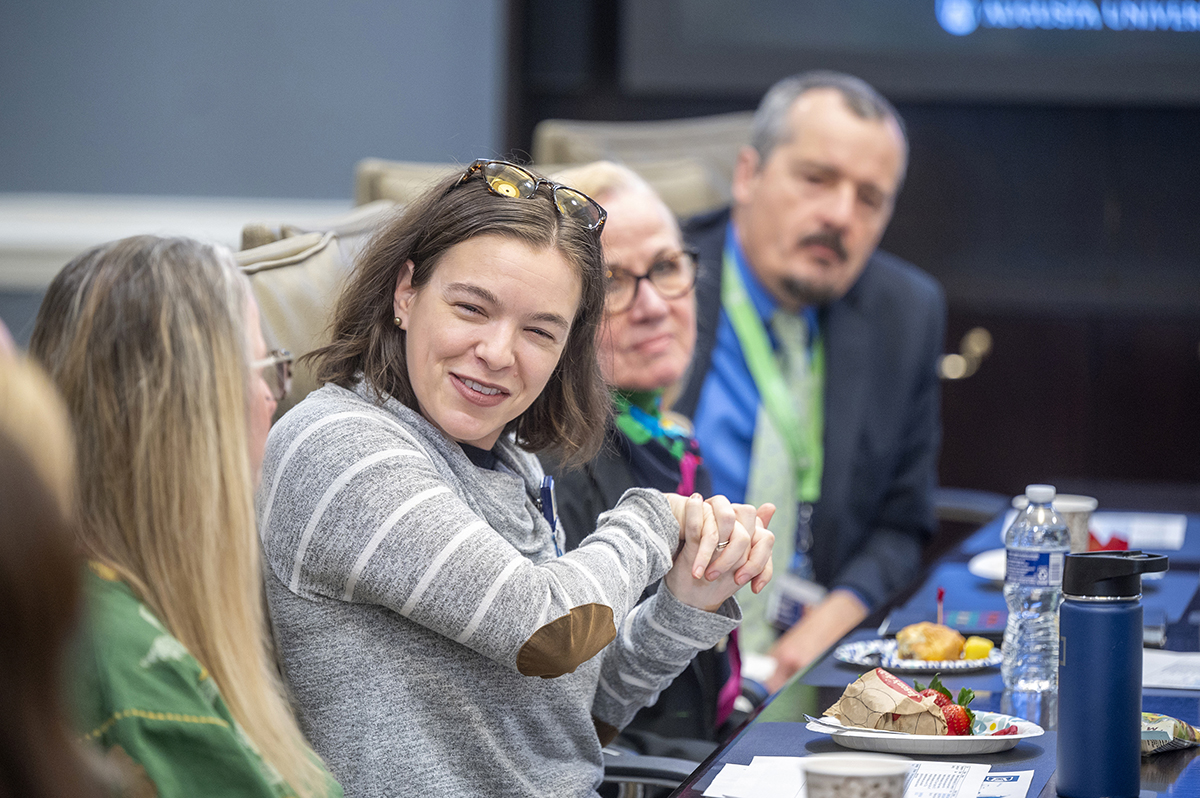
Provost Learning Communities give small groups of faculty members (8-10) the opportunity to explore teaching and learning topics with colleagues from across campus. Together, in a supportive and non-evaluative community, members will meet regularly throughout the academic year to discuss a topic of interest. The community will be facilitated by a Provost Learning Scholar, who will help guide the learning community toward its goals. At the end of the program, participants will be able to point to a change or innovation they have implemented in their course. Books and other necessary supplies will be provided.
For the 2026-27 academic year, faculty may choose from the following topics:
-
A Culture of Collaboration: Designing Team Projects for Learning
-
Connecting the Dots: Elevating the Clinical Experience
-
Cultivating Intellectual Character in the Age of AI
-
Developing a Successful Study Abroad/Away Course
-
Leveraging AI Without Compromising Learning
- Mastering Crucial Conversations: Building Trust, Safety, and Connection in the Learning Environment
-
Recognizing How Learning Works to Rethink How We Teach
-
The Impact of Technology on Critical Thinking in Education
-
Thinking About Plagiarism in the AI Age
Please look at the learning community guide (pdf) for descriptions, meeting dates, times, modality, and facilitator information.
Expectations:
Learning communities will meet 4 times each semester for approximately 75 minutes. During the fall, faculty will explore their topic and start developing an instructional intervention. During the spring, faculty members will implement their intervention and reflect on its effectiveness with peers. Additionally, each participant will submit a brief critical reflection that includes:
- A description of the change or innovation that was made to an assignment, activity, or course material.
- An explanation of what you hoped to accomplish with this change or innovation (i.e., your goal).
- A discussion of the outcome for your students.
- An explanation of what you will do differently next time.
- A description of the impact that your participation in this learning community has had on your teaching.
Learning communities may also choose to do a group project such as creating a website, open-access resource, developing a workshop, etc. The group project can be instead of or in addition to their individual instructional intervention.
Benefits:
You’ll be part of an interdisciplinary learning community that delves into a topic of shared interest. Multiple perspectives and building connections with faculty members you might not otherwise get to meet are just a few benefits of participating in a Provost Learning Community. Other benefits include:
Additional benefits include:
- Building your tenure and promotion portfolio. Participation can count towards student success activities, professional development, or teaching and learning efforts.
- Expanding your perspective on teaching and learning beyond your discipline.
- Increasing your involvement in scholarly teaching and the scholarship of teaching.
- Developing a community of colleagues who can continue as an informal support system after the learning community ends.
- Being eligible to become a Provost Learning Scholar, a designation that communicates a strong commitment to being an innovator, collaborator, and highly effective instructor.
Interested?
Please use the registration form (Qualtrics) to share which Provost Learning Community you would like to be part of. Before registering, kindly look at the learning community guide (pdf) to pick PLC topics and meeting dates that work for you. This initiative is supported by the Center for Instructional Innovation. For questions about the program, please email Kalpana Ramgopal (kramgopal@augusta.edu).
Previous Topics
The topics for the 2025-26 academic year were:
- An Exploration of Adaptive Tools to Facilitate Critical Thinking
- Centering Learning Around Community Engagement
- Charisma by Design
- Enhancing STEM Undergraduate Research Experiences
- Grading for Growth
- Making the Invisible Visible
- Safe Automation with AI
- Storytelling in a Gamified Classroom: Designing Impactful Courses for Modern Learners
- Teaching and Learning in a Holistic Classroom
- Teaching as and Teaching to Introverts
- Open Educational Resources – From Using to Producing
- Understanding Our Students: Surveys of Gen Z
The learning community guide has a complete list of learning community facilitators, topic descriptions, meeting times, and modalities.
The topics for the 2024-25 academic year were:
- AI in Teaching and Learning
- Assessment Methodologies in Critical Thinking
- Creating a Vibrant Learning Environment
- Developing a Data-Informed Pedagogy
- Enhancing STEM Undergraduate Research Experiences
- Experiential Learning
- Implications of Cognitive Science Research for Teaching and Learning
- Making Meaningful Connections - How Professional Relationships Can Inform Our Engagement with Students
- Mastering the Digital Classroom: Strategies for Engaging Online and Hybrid Learners
- Motivating and Including Students Through Active Learning
The learning community guide has a complete list of learning community facilitators, topic descriptions, meeting times, and modalities.
The topics for the 2023-24 academic year were:
- Active Learning in Higher Education
-
Being Warm Demanders
-
Coaching Techniques for Teaching and Learning
-
Developing the Whole Person Through High-Impact Practices
- Growth Mindset
- Small Teaching: Making Simple Changes in Our Courses for a Big Difference in Student Learning
- The Power of Collaboration: Using Instructional Rounds to Tackle Problems of Practice (College of Nursing faculty only)
- The Teaching and Assessment of Critical Thinking
- Transparency in Learning & Teaching
- Undergraduate Research
- When Bad Thinking Happens to Good People:
How Philosophy Can Save Us from Ourselves
The learning community guide has a complete list of learning community facilitators, topic descriptions, meeting times, and modalities.