
Ahmed Aleroud
Associate Professor
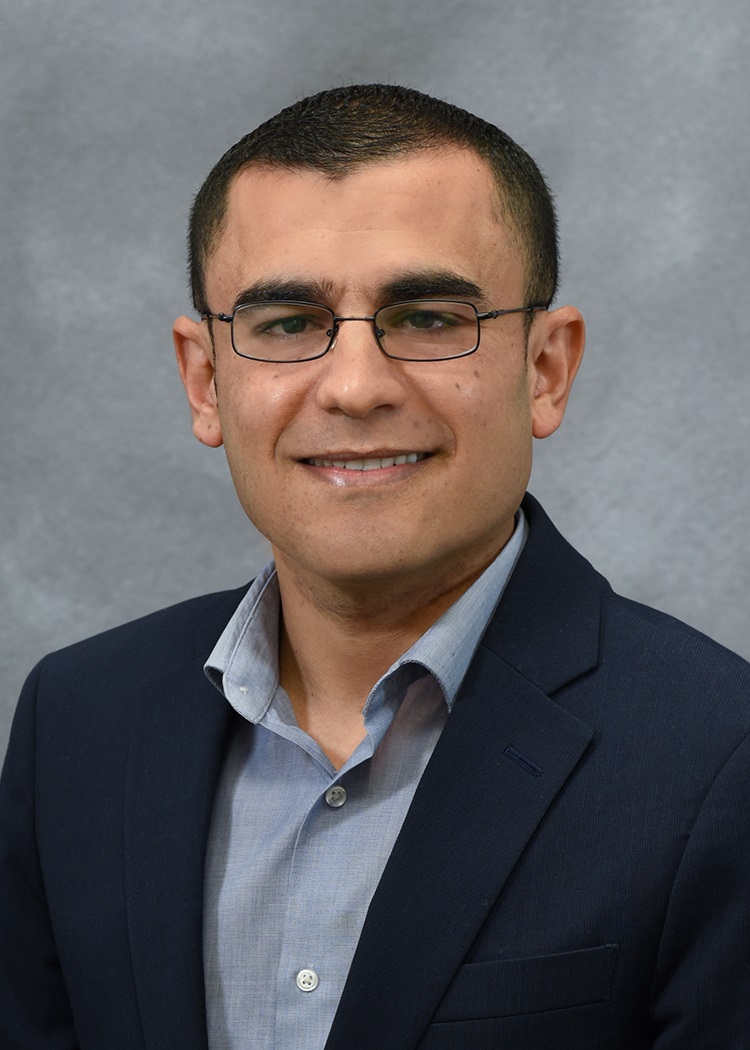
Ahmed Aleroud
Associate Professor
Academic Appointment(s)
Administration
Department of Computer & Cyber Sciences
Bio
Dr. Ahmed Aleroud is an Associate Professor of Cyber Security Analytics at Augusta University. Prior to joining Augusta University, he served as a Visiting Associate Research Scientist and Postdoctoral Fellow at the University of Maryland, Baltimore County, and as an Associate Professor of Information Systems at Yarmouk University in Jordan. He holds a Ph.D. and M.S. in Information Systems from the University of Maryland, Baltimore County, an M.S. in Computer Information Systems from Yarmouk University, and a B.S. in Software Engineering from the Hashemite University in Jordan.
His research focuses on adversarial machine learning and AI, privacy-preserving machine learning, and mitigating social engineering and social media influence cyber attacks. He served as a certified cybersecurity trainer at the Cyber Shield Academy in Jordan.
Dr. Aleroud has published in leading journals such as IEEE Transactions, ACM Digital Threats: Research & Practice, Computers & Security, Information Security and Applications, Information Systems Frontiers, Knowledge and Information Systems, and Social Media + Society. His work has also appeared in major conferences including NOMS, ARES, HICSS, AMCIS, and many others. His research has been supported by the Office of Naval Research (ONR), the Department of Energy (DOE), MITRE, the European IP Networks (RIPE), and the Maryland Innovation Initiative. He has also co-authored two educational and research-focused books on cybersecurity.
- AALEROUD@augusta.edu
- (706) 729-2773
- UH 107
Education
-
Ph.D., Information Science/Studies University of Maryland - Balti, 2014
-
BS, Computer Software Engineering The Hashemite University, 2006
Certifications
-
Cyber Threat Hunting Active Counter Measures(ACM), 2022
-
CITI Human Subjects Research CITI and Augusta University, 2021
Awards & Honors
-
RIPE Academic Cooperation Initiative (RACI) Middle east network operators group, 2018
-
European IP Networks, 2017
Courses Taught Most Recent Academic Year
-
CSCI 8940
Dissertation Research
-
CYBR 3100
Intro Defensive Cyber Operatio
-
AIST 7100
Data Analytics in Security
Teaching Interests
Dr. Aleroud is particularly interested in teaching ethical hacking and penetration testing courses. With hi research and professional experience in cybersecurity analytics, adversarial machine learning, and detecting social engineering attacks, He views ethical hacking as a critical foundation for preparing the next generation of cyber defenders. HE incorporates hands-on, lab-driven learning to help students understand system vulnerabilities, exploitation techniques, and real-world adversarial behaviors. His teaching approach emphasizes responsible use of offensive security skills, encouraging students to think like attackers while upholding strong ethical and legal standards. He is committed to designing practical, scenario-based modules, including network reconnaissance, privilege escalation, adversarial AI testing, and social engineering simulations, that help students build both technical expertise and professional integrity in cybersecurity operations.
Scholarship
Selected Recent Publications
- Powerful \& Generalizable, Why not both? VA: Various Attacks Framework for Robust Adversarial Training, 2025
Conference Proceeding - Generative AI vs. Human Deception: A Comparative Analysis of ChatGPT, Gemini, and Human-Generated Disinformation, 2025
Conference Proceeding - Emotional and Informational Dynamics in Question-Response Pairs in Online Health Communities: A Multimodal Deep Learning Approach, 2025
Journal Article, Academic Journal - Augmented Tabular Adversarial Evasion Attacks with Constraint Satisfaction Guarantees, 2025
Conference Proceeding - Adversary-Resilient Clustered Federated Learning for Secure AI-Driven Healthcare Data Analytics, 2025
Conference Proceeding
Research Interests
Privacy preserving data analytics
Adversarial AI/ML
Social Engineering and Social Media influence attacks
Department Service
-
Faculty search 2022 - Present
Role: Attendee, Meeting
-
data science curriculum, program 2022 - Present
Role: Committee Member
College Service
-
2021 - 2021
Role: Attendee, Meeting
University Service
-
Graduate Research Day Judge 2022 - 2022
Role: Student Placement
Professional Service
-
ACM Transactions on Intelligent Systems and Technology (TIST) 2021 - Present
Role: Reviewer
-
Review committee 2021 - 2021
Role: Reviewer